Ethical Management
- home
Sustainability
Ethical Management
Ethical Management
- Composition System
- Ethics Charter
- Ethical Management
- Code of Conduct
- Sexual Harrassment Prevention Guidelines
- Operating Regulations of Job-Related Integrity Contract of Executives
Composition System
Executives' Job-Related Integrity Contract
-
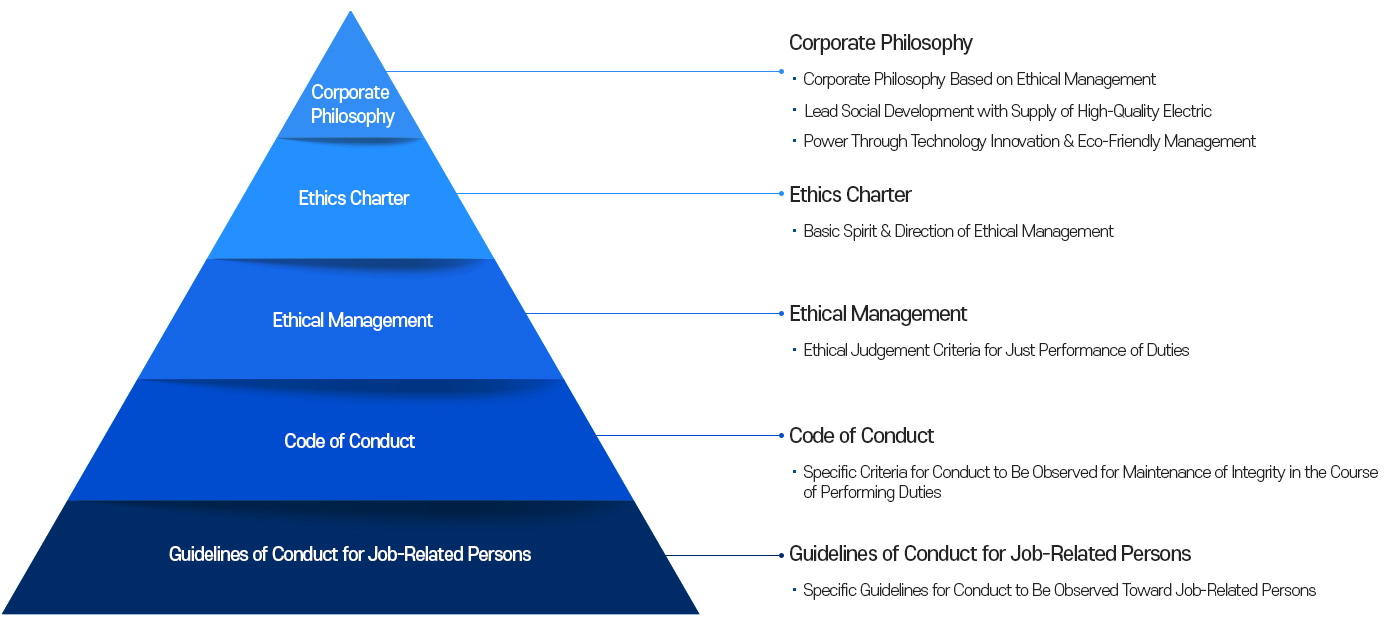
- Corporate Philosophy
-
- Corporate Philosophy Based on Ethical Management
- Lead Social Development with Supply of High-Quality Electric
- Power Through Technology Innovation & Eco-Friendly Management
-
- Ethics Charter
- Basic Spirit & Direction of Ethical Management
-
- Ethical Management
- Ethical Judgement Criteria for Just Performance of Duties
-
- Code of Conduct
- Specific Criteria for Conduct to Be Observed for Maintenance of Integrity in the Course of Performing Duties
-
- Guidelines of Conduct for Job-Related Persons
- Specific Guidelines for Conduct to Be Observed Toward Job-Related Persons
Ethics Charter
We, Komipo, intend to become the world’s top power company transcending Asia by playing a pivotal role in the economic development through stable supply of electric power and contributing to the development of the nation and society.
For this, KOMIPO should establish a respected corporate image of integrity and sustainable growth through fair and transparent management contributing actively to the social development by gathering all its capabilities into one and dispelling bad practices and irregularities. Therefore, we enacted the behavior and value judgement criteria of all executives & employees as ethics charter and assure to practice it strictly.
-
1
We will become an enterprise contributing to the human society through sound corporate activities.
-
2
We will contribute to the improvement of the rights and interests of our customers and to the development of regional communities.
-
3
We will recognize the dignity and the value of individual employees and endeavor to enhance the mental and materialistic life.
-
4
We will improve fair contract order and partnership cooperative relationship with our cooperation companies at an equal position to them.
-
5
We will maintain sound life attitude with frugality and honesty as basic virtues and take the lead in carrying out businesses without irregularities and suspicions.
-
6
We will not use the informations acquired in relation to businesses for individual interests or other purposes that have nothing to do with the company.
-
7
We will observe law and order and strive to establish economic order by denouncing unfair trades.
-
8
We will achieve a productive labor-management relationship of co-existence and common prosperity based on mutual trust and understanding between labor and management.
Ethical Management
Chapter 1. Corporate Social Responsibility
Article 1 (Pledge of Ethical Corporate Activities)
-
-
KOMIPO will firmly establish a fair and transparent ethical corporate culture and grow together with all stakeholders. (revised : Oct. 28, 2011)
-
As a good corporate citizen, KOMIPO will strictly observe various rules & regulations at home and abroad as well as international conventions.
-
Deleted. (Oct. 28, 2011)
-
Article 2 (Promise to Regional Communities)
-
-
KOMIPO will respect the traditions and cultures of regional communities and do its best to pursue common prosperity and development with regional communities.
-
KOMIPO will actively support diverse social and cultural activities through exchanges with regional communities and fulfill its social responsibilities. (revised : Oct. 28, 2011)
-
Article 3 (Pledge for Environmental Conservation)
-
-
KOMIPO will pursue pre- and post countermeasures to address environmental issues related to power generation businesses and exert utmost efforts to prevent environmental pollution and protect the natural environment.
-
KOMIPO will abide strictly by domestic and overseas environment-related laws and regulations as well as all the related criteria of the company and pursue the goal of being a model eco-friendly enterprise. (revised : Oct. 28, 2011)
-
Chapter 2. Responsibilities Toward Customers & Cooperating Companies (revised : Aug. 3, 2009)
Article 4 (Customer-Oriented Management)
-
-
Placing top priority of its corporate activities on customer value, KOMIPO will provide the highest-quality electric power and services. (revised : Oct. 28, 2011)
-
While always providing transparent and correct information to customers, KOMIPO will accommodate customer opinions faithfully and process matters related to customer dissatisfaction rapidly and notify the customers of its processing result. (revised : Oct. 28, 2011)
-
Deleted. (Oct. 28, 2011)
-
Article 5 (Fair Trade with Cooperating Companies) (revised : Aug. 3, 2009)
-
-
Practicing honest and fair trade with cooperating companies, KOMIPO will establish cooperative partnership relations with them. (revised : Aug. 3, 2009)
-
For those cooperating companies equipped with qualifications, KOMIPO will provide equal trade opportunities and pursue transactions in accordance with fair procedures. (revised : Aug. 3, 2009)
-
Utilizing its preferential position, KOMIPO will not engage in any unfair or illegal behavior, including transfer of unfair expenses, toward its cooperating companies. (revised : Aug. 3, 2009)
-
Chapter 3. Responsibilities to Shareholders & Investors
Article 6 (Protection of Shareholders' Interests)
-
-
With reasonable investment and efficient management, KOMIPO will do its best to realize the interests of its shareholders.
-
Through active publicity activities, KOMIPO will endeavor to have its corporate value receive fair assessment.
-
Article 7 (Transparent Management)
-
-
KOMIPO will make public corporate information on the status and future prospects of the company transparently to all its stakeholders as well as to shareholders. (revised : Oct. 28, 2011)
-
KOMIPO will record, manage and process its accounting in accordance with related laws & ordinances and generally accepted corporate accounting criteria.
-
KOMIPO will strive to expand opportunities for the participation of its shareholders in the company's important decision-making processes and provide them with related information to the fullest extent so that the rights and interests of its shareholders can be substantially guaranteed. (revised : Oct. 28, 2011)
-
Article 8 (Protection of Company Property & Information)
-
-
KOMIPO will not allow its property to be transferred or utilized outside of the company through unfair or illegal methods and will not allow it to be used by corporate personnel for other than official business.
-
KOMIPO will take due precautions to protect the company's confidential information from being compromised externally. (revised : Oct. 28, 2011)
-
For information acquired in the course of doing business, KOMIPO will use it only for making corporate decisions or processing business matters and will not leak it externally without prior permission or approval.
-
Chapter 4. Relationship Between Company & Employees
Section 1. Company Responsibilities for Employees
Article 9 (Human Respect)
-
-
KOMIPO recognizes the dignity and value of its employees and considers ways to enhance their quality of life.
-
Respecting the private life of individual employees, KOMIPO will make efforts to resolve their difficulties and/or hardships.
-
KOMIPO will provide maximum possible generosity for results that derive from its employees doing their best.
-
Article 10 (Fair Treatment)
-
-
KOMIPO will stimulate the creativity of its employees and provide equal opportunities in line with their capabilities and talents.
-
While eliminating factions based on regional, academic and blood relations, KOMIPO will operate its organization in accordance with the principles of fair competition. (revised : Oct. 28, 2011)
-
Article 11 (Support for Self-Development)
-
-
KOMIPO will support the capability development of its employees through diverse means to the maximum extent.
-
KOMIPO will form the best environment in which its employees can generate creativity and develop abilities.
-
Article 12 (Working Environment)
-
-
KOMIPO will develop its organizational culture in a way that its employees can feel self-respect and pride regarding their work and jobs. (revised : Oct. 28, 2011)
-
KOMIPO will provide optimum working conditions and environment, protecting its employees‘ health and safety. (revised : Oct. 28, 2011)
-
Section 2. Employee Responsibilities to Company
Article 13 (Fair Duty Performance)
-
-
For achievement of corporate visions, employees will actively cooperate, transcending the interests of individuals and the departments or teams they belong to. (revised : Oct. 28, 2011)
-
Employees will observe relevant laws & ordinances and all the regulations of the company and do their best to create profits for the company.
-
In the event that the interests of individuals conflict with those of the company, employees will consider the company's interests preferentially within the scope of ethics. (revised : Aug. 3, 2009)
-
Employees will not make any unfair or illegal requests or provide money, goods or entertainment and will not receive any money, goods or entertainment from job-related persons of cooperating companies. (revised : Aug. 3, 2009 and Oct. 28, 2011)
-
Article 14 (Sound Life Posture)
-
-
By carrying out all businesses transparently and justly, employees will spearhead the establishment of ethics in organizational society.
-
Employees will maintain their own and company's honor and grace through reasonable and ethical implementation of businesses. (revised : Oct. 28, 2011)
-
Under the basic virtues of honesty and sincerity, employees will manage a sound social life.
-
Article 15 (Self-Development)
-
-
With an attitude to become the foremost experts in their field, employees will endeavor for self-development ceaselessly.
-
Employees will make efforts to innovate and improve with a challenging attitude and always contribute to the development of the company. Article 16 (Job Environment & Safety)
-
Employees will maintain a clean & orderly daily life and create a pleasant working environment.
-
Employees will abide by safety management regulations thoroughly and strive for prevention of safety accidents
-
Section 3 (Relationships Between Employees)
Article 17 (Enhancement of Colleague Awareness)
-
-
Employees shall endeavor to stimulate community awareness and warm colleague relationships pursuing common goals by treating each other with trust and integrity.
-
Employees shall not mutually permit nor sympathize with unjust activities but will correct them as soon as possible, and pursue the development of the Company and individuals.
-
Article 18 (Prohibition of Mutual Money Trade)
-
-
Employees will not be allowed to accept money, goods or entertainment between them except for cases that are recognized in view of common social practice.
-
In other than business relationships, private approaches or transactions between employees is not allowed.
-
Chapter 5. Labor-Management Harmony
Article 19 (Harmonizing Labor-Management Relationship)
-
-
Based on mutual trust and harmony, KOMIPO will prepare a win-win labor-management relationship for co-existence and common prosperity. (revised : Oct. 28, 2011)
-
KOMIPO will prepare smooth communication channels and actively endeavor to resolve conflicts within its organization in advance.
-
Article 20 (Responsibilities of Company & Employees)
-
-
KOMIPO will actively develop and implement programs that enhance the quality of life for its employees, including creation of cultural environment and expansion of welfare & sanitary facilities.
-
Having a sense of balance from the perspective of the whole organization, employees shall make efforts for the sustainable development of the individual and the Company.
-
Supplementary Provisions
-
TThese regulations will go into effect as of the date of promulgation.
Supplementary Provision (Aug. 3, 2009)
-
TThese regulations will go into effect as of the date of promulgation.
Supplementary Provision (Oct. 28, 2011)
-
TThese regulations will go into effect as of the date of promulgation.
Code of Conduct
Chapter 1. General Provisions
Article 1 (Purpose)
-
The Code of Conduct (hereinafter, referred to as the "code") aims to specifically define the standards of conduct to be followed by employees, in relation to the job performance of employees of Korea Midland Power Co., Ltd. (the "company" hereinafter) for the efficient operation of the Charter of Ethics and Code of Ethics of the Company. (Revised: 2009.08.03, 2014.06.24)
Article 2 (Definitions)
-
The terms used in this code are defined as follows: (Revised: 2009.08.03)
-
-
'Employee' means all the executives and employees who provide labor services and receive wages for them, including the CEO and auditor.
-
'Head of Competent Department' as the chief of an organization where related employees are assigned, means head of department (office) or business place for ordinary employees, head of division for heads of department (office) and CEO for heads of division.
-
'Job-Related Person,' as a person other than employees related to the competent businesses of executives and employees, means an individual (in case one is in a private person's position, he is considered an individual) or an organization, who is relevant to one of the criteria in the following paragraphs below:
- A. Who is filing or apparently intending to file a civil petition in connection with Company businesses.
- B. Who is a target person for approval, permission, audit, supervision, inspection, etc.
- C. Who requested or apparently is intending to request Company compensation
- D. Who will receive direct advantage or disadvantage due to the Company's decisions on policies and projects or implementation of them
- E. Who will or intends to conclude contracts with the Company
- F. Who requests specific acts of the Company or who will receive influence of monetary interests due to implementation or non-implementation of rights by the Company's employees relating to their job
- G. Other person who is related to the businesses provided by the Company for prevention of corruption
-
'Job-Related Employee' means one of those relevant to the criteria in the following paragraphs among other employees receiving direct advantage or disadvantage in connection with employee duty performance.
- A. A lower-grade employee receiving orders in connection with the duties assigned to him or her.
- B. An employee other than the persons performing duties, including personnel affairs, budget, audit, awards presentation or assessment
- C. If mandating or entrusting duties, an employee who receives the duties
- D. Any other executive or employee designated by the Company
-
'Gift' means goods or securities, accommodation ticket, membership card, admission ticket, etc. provided without giving equivalent compensation (inclusive of such cases that are remarkably low in market prices or trivial compared with business practices).
-
'Entertainment' means conveniences such as provision of food, invitation for golf, etc. or transportation service, accommodation, etc.
-
'Cooperating Company' means any firm scheduled to be a target for project, service or supply contracts or engaged in business transactions with the Company. (Added: 2013.10.29)
-
"The scope of ordinary practice" refers to the extent of practice that a normal person can understand and accept according to the ordinary social practices. (Legislated: 2014.06.24)
-
"Preference" refers to any act which inhibits fair trade or competition by discriminating in favor of or giving a dominant position to a specific person or group against any other person or group without any clear grounds such as laws, regulations or any other evidence. (Legislated: 2014.10.13)
-
"Placement" refers to introduction, advice, arbitration, or mediation done by an employee who is not a direct party for the purpose of affecting the job performance or decision-making conducted by the person or employee involved in the work. (Legislated: 2014.10.13)
-
"Solicitation" refers to the act of asking favors by an employee for the purpose of affecting the job performance or decision-making conducted by the person or employee involved in the job for his or her own benefit or someone else's benefit. (Legislated: 2014.10.13)
-
"Job-related information" refers to the important information related to the technology development of the company which staff learn while they perform their job and which can provide benefits to the person who acquires it and isn’t yet made public. (Legislated: 2015.6.19)
-
Article 3 (Scope of Application)
-
This code applies to all employees of the Korea Midland Power Co., Ltd. and shall also apply to the transferred or dispatched employees who work in domestic or overseas investment companies of Korea Midland Power Co., Ltd. However, in case of employees dispatched from other agency or organization, although they are subject to the code of conduct of the Korea Midland Power Co., Ltd., disciplinary procedures for them shall be applied in accordance with the provisions of the original institution or organization. (Revised: 2013.10.29., 2015.10.14)
Chapter 2. Fair Performance of Duties
Article 4 (Duty Performing Attitude)
-
-
Employees shall faithfully abide by domestic laws, international laws, the 10 Principles of the United Nations Global Impact and the criteria provided in this code.
-
Employees, when meeting with cooperating companies to discuss business matters, shall always use a separate meeting room designated by the Company. In the event of a meeting accompanied by business-related meals, they shall notify the 'Report Center on Meeting With Cooperating Companies' of the fact in advance and then engage in the meeting. (added: 2009.08.03)
-
Article 4-2 (Processing of Instructions Undermining Fair Duty Performance, etc.)
-
-
Employees shall not give any instructions to lower-grade employees that may harm fair performance of duties for their own interest or others in violation of laws & ordinances or regulations. (Revised: 2009.08.03)
-
Employees who receive instructions that violate Paragraph ① shall make a plea to their upper-grade employees and will not follow the instructions or shall consult with the head of the ethical affairs department. (Revised: 2009.08.03., 2011.10.28)
-
In the event that the same instructions are repeated despite non-implementation in accordance with Paragraph ②, the relevant employees shall immediately consult with the person in charge of the Code of Conduct (Revised: 2009.08.03)
-
The person in charge of the Code of Conduct who receives a request for consultation in accordance with Paragraph ② or ③ shall confirm the content of the instructions and take proper measures, including cancellation or change of the instructions. In such a case, the person may take necessary measures, including disciplinary action, for the upper-grade employees who repeated the same instructions notwithstanding non-implementation of the instructions undermining fair duty performance according to Paragraph ③. (Revised: 2009.08.03., 2011.10.28)
-
A plea provided in Paragraph ② shall be submitted as a Letter of Explanation (Plea) of Annex 1 or made with an equivalent method.
-
Employees shall not receive any discrimination or disadvantages due to non-implementation of the instructions cited in Paragraph ①, and if the employees so request, the Company can take such measures as transfer to their desired department. (revised: 2013.10.29)
-
The judgment criteria for unjust instructions are as per Annex 1-1. (added: 2013.10.29)
-
Article 5 (Avoidance of Interest-Related Duties)
-
-
Employees, if duties carried out by themselves are related to one of the following paragraphs, shall proceed with the duties only after consultation with their upper-grade staff or the head of the ethical affairs department on avoidance of duties, etc. If the head of the department to which they belong judges that they are simple civil petitions, which do not affect fair performance of duties, however, it will not be necessary. (Revised: 2009.08.03., 2011.10.29)
- A. If directly related to the monetary interest of themselves, their lineal ascendants (descendants), spouses or lineal ascendants (descendants) of their spouses
- B. The person whose relative as defined by 「Civil Act」 Article 777 is an employee involved in the work (Revised: 2014.10.06)
- C. If the organization or an agent of the organization where they served within the last two years is a job-related person
- D. If a retired employee or an organization to which they belong is a job-related person (Added: 2011.10.28)
- E. If related to an organization where their spouses, lineal ascendants (descendants), brother, sister or lineal ascendants (descendants) of brother or sister of their spouses are working as employees
- F. Those businesses involving themselves, including personnel affairs or multi-sources assessment and resolution of disciplinary action. (Added: 2013.10.29)
- G. Those businesses directly related to themselves, including sale and purchase of assets. (Added: 2013.10.29)
- H. The person who is considered to have difficulty in conducting fair job performance because of regional relation, family ties, school ties, religion, gender, or relationship with coworkers. (Revised: 2013.10.29., 2014.09.24)
- I. Among those who provided direct benefits through licensing, conclusion of contracts, or decision or execution of policies or projects within recent two years, the one who is considered to have difficulty in conducting fair job performance because ongoing friendship has been formed. (Legislated: 2014.09.24)
-
The upper-grade person or the head of ethical affairs who receives a request for consulting, if he or she thinks that it is not proper for the relevant employee to carry out duties continuously, shall report the fact to the head of the department to which the employee belongs. In the event that the upper-grade person can reassign the duties of the relevant employee temporarily within the scope of his or her rights, however, he or she may reassign the duties and may not report to the head of the department to which the employee belongs. (Revised: 2009.08.03., 2011.10.28) A~E: Deleted (2009.08.03)
-
The head of the department who receives a report in accordance with Paragraph ② shall take necessary measures, including reassignment of manpower so that duties can be processed fairly. (Revised: 2009.08.03)
-
Article 6 (Exclusion of Preference (Revised: 2009.08.3)
-
Employees shall not discriminate or give preference to a specific person or group on unreasonable grounds such as regional relation, family ties, school ties, religion or gender. (Revised: 2009.08.03, 2014.06.24)
Article 7 (Prohibition of use for other purposes except for budget)
-
-
employees must not use a corporate card privately and must not use the budget for travel expenses, business promotion expenses, etc. for other purposes, executives and vice-chiefs in level 1 or higher(ministers· section chiefs· business director) shall post monthly their business promotion expenses records on the website including dates, purposes, subjects, places of use, amounts on a case-by-case basis within 30 days after monthly termination(2014.09.24 revision)
-
employees must not use the gift certificates distributed · paid by a company for the purpose of the public for other purpose, or privately and must not buy· use them improperly, and shall post the details of distributing gift certificates on the website. In particular, in case of each paragraph, it shall not be permitted even in connection with a company’s work. Other requirements shall apply the guidelines of a company’ gift certificates management.
- ① The act of paying gift certificates to supervisory· superior authorities on holidays
- ② The act of paying gift certificates to supervisory· superior authorities· press officials, etc. for reasons such as business promotion
- ③ The act of paying gift certificates to internal staffs for encouragement without a special reason
- ④ The act of paying gift certificates for other purposes beyond common sense (2009.08.03., 2011.10.28, 2014.03.31, 2015.06.19 revision)
-
Article 8 (Processing of Unjust Requests from Outside)
-
-
Employees, if receiving requests from outside, including public servants, politicians or political parties, to carry out unjust businesses forcibly or receiving solicitations, shall proceed with the businesses only after reporting to the head of their department or the head of ethical affairs or consulting with them. (Revised: 2009.08.03., 2011.10.28.)
-
The head of the department or the head of ethical affairs who receives a report in accordance with Paragraph ① shall take necessary measures so that the employees can carry out the businesses fairly. (Revised: 2009.08.03., 2011.10.28)
-
Article 9 (Prohibition of Personnel Solicitation, etc.)
-
-
Employees shall not allow others to solicit the person in charge of personnel affairs to influence personnel affairs, including their promotion, transfer or assignment to a position. (Revised: 2009.08.03)
-
Employees shall not interfere in personnel affairs, including the promotion, transfer or assignment to a position of other employees, using their job positions or responsibilities. (Revised: 2009.08.03)
-
Article 9, Section 2(Prohibition of requesting special consideration for employees’ family or stakeholders)
-
employees must not request special consideration using their positions or authorities so their family, etc. or stakeholders may be adopted in a company or its investment companies. [2014.06.24 New Article]
Article 9, Section 3 (Restriction of requesting special consideration for employment during one’s tenure of office)
-
employees must not request special consideration for their and other employees (others)’ employment to job parties or corporate partners Especially, employees expected to retire must not ask private companies closely related to the department they belong to for their employment during their tenure of office for three years before retirement. [2014.09.24 New Article](2015.10.14 revision)
Article 9, Section 4 (Prohibition of undue political intervention)
-
-
employees must not intervene politics unfairly according to laws related to the political party law, public offices election law, political finance law, etc. (2015.10.14 revision)
-
employees must be careful so the political views of them may not to be misunderstood as those of the company in their political activities [2015.06.19 New Article](2015.10.14 revision)
-
Article 10 (Transparent Information and Accounting Management)
-
-
Employees shall acquire and manage all information justly and transparently and shall record and manage the information on accounting records, etc. correctly and honestly based on the facts in accordance with related laws & ordinances and generally accepted accounting principles, etc. (Revised: 2013.10.29)
-
Employees shall not leak job-related information externally or use it unjustly without prior approval or permission of their department head. (Added: 2013.10.29)
-
Employees shall not give any false or exaggerated report for the interests of any specific individuals or departments or shall not conceal or fail to share important information. (Added: 2013.10.29)
-
Employees shall make public management information in accordance with related laws & ordinances and regulations and shall not engage in any acts that may damage the transparency and credibility of the management. (Added: 2013.10.29)
-
Article 10, Section 2 (Intellectual property rights protection)
-
-
employees must comply with the relevant regulations and laws in the use of the intellectual property rights of a company.
-
employees must not have legal· moral effects on a company by stealing or abusing the intellectual property rights of others for the purpose of performing the work of a company.
-
employees must purchase and use all genuine softwares. [2015.06.19 New Article]
-
Article 10, Section 3 (Duty of whistleblowing)
-
-
employees must report to the whistleblow center on the external website or research institutions, investigative agencies, the anti-corruption and civil rights commission when getting to know public violations during performing their duties.
-
Detailed procedures for whistleblowing shall comply with the instructions for whistleblowing process and whistleblower protection. [2015.10.14 New Article]
-
Chapter 3. Prohibition of Reception of Unjust Enrichment, etc.
Article 11 (Prohibition of Involvement in Rights & Interests, etc.)
-
-
Employees shall not acquire any unjust enrichment or shall not let others acquire or obtain enrichment by using their job position directly. (Revised: 2009.08.03)
-
Employees must not participate in investment projects which cannot be accepted according to social norms, or lend their names. (2015.10.14 New Article)
-
Employees must not receive the cost associated with the work for any reason, and must not provide gratuities or benefits of property or promise to provide them. (2015.10.14 New Article)
-
Article 12 (Prohibition of Private Usage of Job Position)
-
Employees shall not use or let others use their position for private interests outside of their duty scope through such methods as announcing or posting the Company's name or job positions. (Added: 2009.08.03)
Article 13 (Prohibition of Good Offices, Solicitations, etc.)
-
-
Employees shall not engage in such acts as good offices and solicitations that undermine other employees' fair implementation of duties for their own or other persons' interests. (Revised: 2009.08.03., 2012.09.04)
-
In connection with their implementation of duties, employees shall not introduce job-related persons to other job-related persons or public officials in line with Article 2-3 of the Act on the Establishment & Operation of Anti-Corruption and Civil Rights Commission of Korea for the unjust interest of themselves or others. (Revised: 2009.08.03)
-
If employees would be solicited from people such as job parties, job-related staffs, etc., they must register those who solicit and the information immediately in the bribery and solicitation report system. (2011.10.28 New Article)(2015.10.14 revision)
-
Article 13, Section 2 (Restriction of Employment of Retired Persons at Cooperating Companies)
-
-
Employees of grade 1 or above shall not be employed at cooperating companies for three years after their retirement date.
-
Employees of grade 2 or lower, if employed at cooperating companies, shall notify the Company of the fact within one month from the employment date. (Revised: 2013.10.20)
-
Article 13, Section 3 (Prohibition of the preferential treatment for retired public officers, etc)
-
-
employees must not contact job parties, company retirees privately according to each paragraph in carrying out their duties.
① The act of playing golf with job parties, retirees
② The act of having a meal or gambling with job parties, retirees. However, for meals, if job parties do not organize them, it could be excluded
③ The act of traveling with job parties, retirees
-
Employees must not leak confidential information known with regard to duties to retirees.
-
If employees find the fact of doing the acts corresponding to subsection 1 and 2 receive the offer, they can report them to persons in charge of behavior rules.
-
Persons in charge of behavior rules must take action such as guarantee of status in accordance with Article 28 for reporters.[2014.06.24 New Article]
-
Article 14 (Restriction on Trade, etc. Utilizing Job-Related Information)
-
-
Utilizing non-public information acquired during implementation of duties, employees shall not conduct property trades related to securities, real estate, etc., investment or provide information to help others to conduct property trade or investment. (Revised: 2009.08.03)
-
Employees must not trade or invest in stocks and securities of companies related to their duties directly for property in the name of themselves or others. (2015.06.19 New Article)
-
Article 15 (Prohibition of using· making a profit on objects for public use)
-
-
Employees must not use· make a profit on public property of a company such as company vehicles· vessels and articles, other movable assets, real estate, intellectual property rights, etc. provided for a variety of business and extra service such as airline miles, earn points, gift certificates provided by the use of budget for private use without valid reasons. (2009.08.03, 2015.06.19, 2015.10.14 revision)
-
When the offense in subsection 1 is caught, the full cost of using and acquiring public property privately can be confiscated(it’s possible to confiscate about 3 times of the amount of damages, including the principal of public property damage and its interest expense. (2014.09.24 New Article)
-
Article 16 (Restrictions on Receiving Money & Goods)
-
-
Employees are prohibited from accepting money, real estate, gifts or entertainment (hereinafter referred to as 'money, etc.'). However, if related to one of the following items, the restrictions will not apply. (Revised: 2009.08.03)
A. Money, etc. provided for the legal exercise of rights, including fulfillment of obligations
-
B. Simple meals and convenience like communications and transportation services provided within the scope of general practices (maximum 30,000 won) in the event of an unavoidable case in the course of carrying out duties by employees (Revised: 2009.08.03)
C. Transportation, accommodation or food provided by the host of an official event related to duties and equally available to all participants (Revised: 2009.08.03)
D. Souvenirs or publicity items for distribution to a number of unspecified persons
E. Money, etc. provided openly to help those employees in difficulties due to disease, disaster, etc.
F. Others, including money, etc., provided by executives and heads of related departments for smooth implementation of duties (Revised: 2009.08.03)
-
Employees shall not accept money, etc. from job-related employees. However, if related to one of the following items, the restrictions will not apply. (Revised: 2009.08.03)
A. If related to one of the items in Paragraph ① (Revised: 2009.08.03.)
B. Gifts of small value (maximum 30,000 won) provided within the scope of general practices (Revised: 2009.08.03.)
C. Money, etc. provided publicly from the employee mutual aid association, etc.
D. Money, etc., including consolation, encouragement and presentation of awards, provided by upper-grade employees to lower-grade employees for the purpose of enhancing morale (Revised: 2009.08.03.)
-
Employees shall not accept money, etc. from those who were job-related persons or job-related employees in connection with their duties at that time. However, if related to any of the items in Paragraphs 1 or 2 above, the restrictions will not apply. (Revised: 2009.08.03.)
-
Except for money, etc. related to congratulations and condolences, employees shall not offer or accept money (parting money, support money for overseas travel, etc.) or orchids and flower pots for personnel affairs, including promotion and transfer, mutually between employees in any case.
-
Article 16, Section 2 (Restriction of asking job parties for sponsorship)
-
-
Employees must not ask job parties for sponsorship using their position in organizing events such as athletic competition, helping needy neighbors, hobbyists activities, etc. supported by a company. However, if they proceed with events together with job parties, it could be excluded.
-
Sponsorship in accordance with Subsection 1 means that expenses· articles· service· HR or places needed directly· indirectly for events are provided. [2014.06.24 New Article]
-
Article 16, Section 3 (Restriction on Future Guarantee)
-
When employees are under employment, they shall not accept any offer of special benefits such as employment after retirement, job placement or conclusion of a transaction contract from a person or people involved in the job. (Legislated: 2015.06.19)
Article 17 (Restriction on Spouse’s or Family’s Reception of Gifts)
-
Employees’ spouses and families shall not receive gifts of money or goods prohibited under Article 16, and the inappropriate act of the spouse or family of an employee is regarded as the employee’s own act. (Revised: 2013.10.29, 2014.06.24)
Article 18 (Prohibition of Providing Money, etc.) (Revised: 2009.08.03)
-
-
Employees shall not provide money, etc. to those employees that have been prohibited from accepting money, etc. from them in accordance with Article 16-2. However, cases defined in the respective Paragraph of Article 16-2 are excluded. (revised: Aug. 3, 2009)
-
Employees shall not provide bribes to job-related people, politicians or civil servants or shall not offer business vehicles, mobile phones, free gifts of corporate credit cards or payment for meals. However, this regulation does not apply to the cases specified in the subparagraphs of Article 16, paragraph 1. (Revised: 2009.08.03, 2015.06.19)
-
Article 18, Section 2 (The Establishment of the Culture of Integrity in International Commercial Transactions)
-
-
Employees shall comply with relevant national laws and international laws and regulations, such as the OECD Anti-bribery Convention, the United Nations Convention against Corruption in order to establish the culture of integrity in international commercial transactions. In particular, it is strictly prohibited to provide more than customary gifts and entertainment to those involved in business (employers, officials, and politicians who have influence on business orders) in order to obtain a new business order.
-
Employees shall take adequate measures to prevent unethical behavior occurrences, such as the exchange of integrity pledges between business parties when they proceed with foreign business.
-
The presidents of the domestic and overseas corporations shall take separate integrity pledges from the employed involved in order to strengthen the integrity in international business transactions, and take necessary measures under their own responsibility such as enforcing the regular integrity and ethics training. [Article legislated: 2014.06.24]
-
Article 19 (Conclusion & Implementation of Clean Contracts)
-
-
In the Company's bidding for all projects, purchase of goods & services and conclusion & implementation of contracts, employees shall carry out businesses fairly and transparently in accordance with related laws & ordinances and the procedures provided in intra-company regulations. (Revised: 2009.08.03)
-
Employees shall not require money and goods prohibited during the process of bidding, contracting and contract implementation with regard to the paragraph 1 by using their superior position in the trade, or make unreasonable demands such as unfair trading conditions, management interference, their re-employment or employment placement of their relatives. (Revised: 2009.08.03., 2015.10.14)
-
Article 19, Section 2 (Prohibition of Decision of Unfair Trading Price)
-
When employees do business with contractors, they shall not decide on the price which is significantly lower than the price normally paid for what is identical or similar to the desired object or shall not force them to accept subcontracting, using unfair methods. (Legislated: 2014.10.06)
Article 19, Section 3 (Prohibition of Coercion to Purchase)
-
In transactions such as construction, service, or delivery agreement, employees shall not force the other party to purchase the goods or equipment or to use the supply of services that they specify, unless there is a legitimate reason, such as the maintenance or improvement of the quality of the desired. (Legislated: 2014.10.06)
Article 19, Section 4 (Performance of Fair Inspections)
-
-
Employees shall receive the goods in the way which is stipulated in the contract when they collect the contract order that the company ordered, and they shall not cause discomfort to the supplier by refusing or delaying the collection without any valid reason.
-
Employees shall perform inspection tasks in fair and valid methods in accordance with relevant provisions when they present the inspection report of the contract work, and shall not delay the inspection work without any good reason. [Article legislated: 2015.06.19]
-
Article 19, Section 5 (Securing Transparency of Proposal Evaluation)
-
-
When employees conduct lectures, presentations, discussions, assessment, evaluation, consultation, decision, etc. at seminars, hearings, debates, presentations, symposiums, training courses or conferences (henceforth, referred to as the "external lecture or conference”) and accept payment, they should report the requester, requesting reasons, place, date and time and compensation of the external lecture or conference in advance to the head of the department they belong to on the basis of official documents in which the amount of compensation paid by the requester and compensation criteria are specified in accordance with the designated form(Appendix 5), and the supervisor should allow the external lecture or conference within the range that does not hinder job duties after strictly confirming the job relevance and work situations.
-
In accordance with the paragraph 1, the compensation that an employee receives for external activities such as external teaching, lectures, or presentations form cannot exceed the criteria specified in Appendix 5-1, and the employee should immediately return the amounts in excess of the standards, and should be able to provide the evidence of returning them. But if there are amounts which cannot be returned due to unavoidable circumstances, they should be reported to the department in charge of ethical management (Revised: 2013.10.29., 2015.10.14)
-
An employee’s external lectures or conferences should not exceed 10 times per year. However, external lectures or conferences without compensation, external lectures or conferences specified in the paragraph 4, and external lectures or conferences which do not require notification are not subject to such restriction.[This article legislated: 2009.08.03] (Legislated: 2013.10.29) (Revised: 2015.10.14)
-
If an employee is appointed a part-time lecturer or an adjunct professor of a college or university or if an employee offers external lectures continuously for a period which exceeds a month, they should receive approval from the company separately from the notification procedures for external lectures or conferences. (Legislated: 2015.10.14 )
-
Employees shall obtain permission from the department head, and in case of remunerative external lectures or conferences, register them on the external lecture and conference filing system in advance by attaching the official document and required forms(Appendix 5) requested by the requester, and if any item is omitted under unavoidable circumstances, they should complete the registration within two weeks after the attendance at the lecture or conference. However, if the requester of the external lecture or conference is the national or local government (including its affiliated organizations), the procedures of the paragraph 1 and 5 may be omitted. (Legislated: 2015.10.14)
-
If the external lecture or conference is job-related or necessary to perform the policy objectives of the company or the nation, private external lectures or conferences should be done by utilizing personal vacations, except for the cases specified in the paragraph 4, and even in these cases, employees should go through the procedures of the paragraph 1 and 5. (Legislated: 2015.10.14)
-
The department in charge of ethics management should conduct investigation of the situations of external lectures and conferences and conduct related education and promotion every six months, and if they find any case of external lectures and conferences which violates the above regulations, they may request audit to the audit department on the basis of investigation results. (Legislated: 2015.10.14)
-
Chapter 4. Creation of Sound Organizational Climate
Article 20 (Notification of External Lectures or Conferences)
-
-
When employees conduct lectures, presentations, discussions, assessment, evaluation, consultation, decision, etc. at seminars, hearings, debates, presentations, symposiums, training courses or conferences (henceforth, referred to as the "external lecture or conference”) and accept payment, they should report the requester, requesting reasons, place, date and time and compensation of the external lecture or conference in advance to the head of the department they belong to on the basis of official documents in which the amount of compensation paid by the requester and compensation criteria are specified in accordance with the designated form(Appendix 5), and the supervisor should allow the external lecture or conference within the range that does not hinder job duties after strictly confirming the job relevance and work situations
-
In accordance with the paragraph 1, the compensation that an employee receives for external activities such as external teaching, lectures, or presentations form cannot exceed the criteria specified in Appendix 5-1, and the employee should immediately return the amounts in excess of the standards, and should be able to provide the evidence of returning them. But if there are amounts which cannot be returned due to unavoidable circumstances, they should be reported to the department in charge of ethical management (Revised: 2013.10.29., 2015.10.14)
-
An employee’s external lectures or conferences should not exceed 10 times per year. However, external lectures or conferences without compensation, external lectures or conferences specified in the paragraph 4, and external lectures or conferences which do not require notification are not subject to such restriction.[This article legislated: 2009.08.03] (Legislated: 2013.10.29) (Revised: 2015.10.14)
-
If an employee is appointed a part-time lecturer or an adjunct professor of a college or university or if an employee offers external lectures continuously for a period which exceeds a month, they should receive approval from the company separately from the notification procedures for external lectures or conferences. (Legislated: 2015.10.14 )
-
Employees shall obtain permission from the department head, and in case of remunerative external lectures or conferences, register them on the external lecture and conference filing system in advance by attaching the official document and required forms(Appendix 5) requested by the requester, and if any item is omitted under unavoidable circumstances, they should complete the registration within two weeks after the attendance at the lecture or conference. However, if the requester of the external lecture or conference is the national or local government (including its affiliated organizations), the procedures of the paragraph 1 and 5 may be omitted. (Legislated: 2015.10.14)
-
If the external lecture or conference is job-related or necessary to perform the policy objectives of the company or the nation, private external lectures or conferences should be done by utilizing personal vacations, except for the cases specified in the paragraph 4, and even in these cases, employees should go through the procedures of the paragraph 1 and 5. (Legislated: 2015.10.14)
-
The department in charge of ethics management should conduct investigation of the situations of external lectures and conferences and conduct related education and promotion every six months, and if they find any case of external lectures and conferences which violates the above regulations, they may request audit to the audit department on the basis of investigation results. (Legislated: 2015.10.14)
-
Article 20, Section 2 (Property Report of Senior Executives)
-
Senior executives and their spouses shall report their personal properties annually in order to take the initiative in spreading culture of integrity through fair job performance. (Legislated: 2014.10.13)
Article 21 (Prohibition of Borrowing Money, etc.)
-
-
Employees shall not borrow money from or lend money to their job-related persons (excluding relatives within cousins) and job-related employees shall not accept use of real estate free of charge (including if the rent is remarkably lower compared with market prices or transaction practices). However, cases of borrowing money with usual conditions from financial institutions in accordance with Article 2 of the Act on Real Name Financial Transactions and Guarantee of Secrecy are excluded. (revised: Aug. 3, 2009)
-
Notwithstanding the provisions cited in Paragraph ①, those employees who intend to borrow money from or rent real estate to job-related persons or job-related employees and receive use of real estate free of charge shall prepare the Borrowing Money (Real Estate Rental) Report (Annex 2) and report it to the head of the department to which they belong. (revised: Aug. 3, 2009)
-
Article 21, Section 2 (Prohibition of Commercial Activities)
-
Employees shall not do any of the non-work related commercial activities that corresponds to any of the following subparagraphs. However, this regulation will not apply in cases which are specified by special legislation or regulations.
-
-
The act of receiving compensation by becoming or being hired as an executive or an employee of a company, union, or other commercial organization.
-
The act of self-management of commercial business
-
The act of the use of an employee’s name by a company specified in the subparagraph 1. [Article legislated: 2015.06.19]
-
Article 22 (Establishment of Sound Congratulation & Condolence Culture) (revised: Aug. 3, 2009)
-
-
Employees shall take the lead in establishing a sound congratulation & condolence culture. (added: Aug. 3, 2009)
-
Employees shall not notify job-related persons of congratulation & condolence events, and employees of 1st grade and above shall refrain from announcing such events to internal employees. However, if related to one of the following items, congratulation & condolence events can be announced. (revised: Aug. 3, 2009) (revised: Oct. 29, 2013)
① Notifications to relatives
② Notifications to employees of the organizations where they are presently working or worked in the past (revised: Aug. 3, 2009)
③ Notifications through newspaper, broadcast or internal communication network, etc., whose audience is restricted only to those employees in Paragraph 2. above. (revised: Aug. 3, 2009)
④ Notifications to members of religious organizations, fraternal organizations, etc. to which the employee belongs (revised: Aug. 3, 2009)
-
Employees shall not offer or accept congratulation or condolence money or goods exceeding 50,000 won. However, if related to one of the following items, the restriction will not apply. (revised: Aug. 3, 2009)
① Congratulation or condolence-related money, etc. exchanged between employees and their relatives
② Congratulation or condolence-related money, etc. provided in line with the articles of association, rules, etc. of religious organizations, fraternal organizations, etc. to which the employee belongs
③ Other congratulation or condolence-related money, etc. provided in the name of agencies or head of agencies. (revised: Aug. 3, 2009 and Nov. 30, 2010)
-
If the employee receives money or goods for congratulation or condolence of family events which exceeds the stipulated standards, he or she shall immediately return it to the provider in accordance with relevant procedures or shall report it to the report system of bribery and solicitation. However, gifts related to family events can be returned or reported immediately after returning from the family event. (Legislated: 2013.10.29) (Revised: 2015.10.14)
-
Article 23 (Right Aquisition & Transparent Management of Information)
-
Employees shall acquire all information related to their jobs through appropriate methods and record & report the information, and shall not manipulate or provide information for the interest of specific individuals or organizations nor shall they delete information. (revised: Aug. 3, 2009)
Article 23, Section 2 (Prohibition of Improper Use of Information and Communication Systems)
-
Employees shall not conduct any act that corresponds to any of the following subparagraphs by means of in-house information and communication systems. (Legislated: 2014.10.13)
-
-
Access to obscene websites, inappropriate chatting, gambling or playing games
-
The use of in-house information and communication systems for improper purposes other than work
-
Article 23, Section 3 (Restriction of Release of Personal Information)
-
When anyone provides important personal information of employees to a third party, they shall specify the purpose and the scope of information release and obtain prior permission or approval from the employees involved. (Legislated: 2015.06.19)
Article 24 (Prohibition of Speculative Behavior and Private Organizations)
-
-
Employees shall not engage in speculative behavior like gambling or betting on golf beyond common social practice. (revised: Aug. 3, 2009)
-
Employees shall not engage in improper golf, including golf entertainment with a job-related person or people, and if they play golf with a person other than those involved in job duties, they shall write their real name in the register which records the golf course use in order to prevent any confusion or misunderstanding. (Revised: 2013.10.29, 2014.06.24)
-
Employees shall not create or join cliques in their work place in connection with blood, regional or academic ties or organize private organizations, including women's associations composed of their spouses. (Revised: 2009.08.03., 2013.10.29)
-
Article 24, Section 2 (Prohibition of Private Business during Work Hours)
-
Employees shall not spend any of work hours doing non-work related personal business, such as pursuing a hobby, religious activity or charity activity which can interfere with job performance. (Legislated: 2014.10.13)
Article 25 (Prohibition of Sexual Harrassment)
-
-
By using their job position or in connection with their duties, employees shall not engage in any one of the following behaviors that may cause sexual temptation or sexual embarrassment for external interested parties, including other employees or job-related persons. (Revised: 2009.08.03., 2013.10.29)
① Touching or contacting any specific body part
② Making obscene jokes or telling vulgar stories
③ Making sexual comparisons or assessments regarding the appearance of the other party
④ Posting or showing obscene photos or pictures
⑤ Compelling drinking or dancing when dining out together
⑥ Other behavior causing sexual humiliation in terms of common social practice
-
Employees shall not engage in behaviors that give disadvantages in employment, business or transactions for the reason of having not responded to acts requested in Paragraph ① above or other demands. (Added: 2013.10.29)
-
Article 25, Section 2 (Restriction on Drinking Violence and other Dignity Damage Actions)
-
Employees shall not damage employee dignity by doing any improper conduct such as drinking-related violence. (Legislated: 2014.10.13)
Article 25, Section 3 (Restriction on Dignity Damage Actions in Bars, Restaurants or Entertainment Establishments)
-
Employees shall not engage in dignity-damaging conducts by going to a bar or any other entertainment establishment and doing inappropriate act with or against the employees of the place. (Legislated: 2015.06.19)
Article 25, Section 4 (Limitation of Unwholesome SNS Activities)
-
-
Employees shall not publish data that may violate of trade secrets of the company in the SNS.
-
Employees shall not compromise the dignity of the company in the SNS
-
Employees shall not engage in any of illegal activities in the SNS, such as defamation of others, human rights violations, personal information leakage, or pornography distribution. [Article legislated: 2015.06.19]
-
Chapter 5. Measures Against Violations (revised: Aug. 3, 2009)
Article 26 (Consulting on Potential Violations)
-
-
While carrying out their duties, if employees themselves are not sure of whether their behaviors are in violation of the Code of Conduct or not, they shall consult with the head of ethical affairs, the person in charge of this code, etc. and then shall proceed the case accordingly. When learning that they have committed a violation, employees shall report the fact to the person in charge of this code or the head of audit department. (Revised: 2009.08.03., 2011.10.28)
-
For those cases reported by employees themselves in line with Paragraph 1 above, the Company can judge whether the violation was intentional or not and may reduce or exempt punishment when taking disciplinary measures. (Added: 2009.08.03)
-
The person in charge of the Code of Conduct shall take necessary measures, including installation of exclusive telephone lines and consulting rooms, so that consulting in line with Paragraph 1 can be conducted smoothly. (Revised: 2009.08.03)
-
Article 27 (Report & Confirmation of Behavior in Violation of the Code)
-
-
When learning the fact that an employee violated the Code of Conduct, anyone can report the situation to the person in charge of the Code, the head of audit department or the Anti-Corruption & Civil Rights Commission. If deemed necessary, however, the person in charge of the Code of Conduct may transfer the case to the auditor's office for processing. (Revised: 2009.08.03., 2011.10.28)
-
If irregularities regarding the reporter are found in the course of a report made in line with Paragraph ①, the Company can judge whether the violation was intentional or not and may reduce or exempt punishment when taking disciplinary measures. (Added: 2009.08.03)
-
Those employees reporting violations in line with Paragraph ① shall prepare and submit the Report of Acts Violating the Code (Annex 6), including detailed personal particulars and the specific violations. (Revised: 2009.08.03)
-
After confirming the violation reported in line with Paragraph ①, the person in charge of the Code of Conduct shall report to the auditor's office after attaching any appeal data received from the related employees. (Revised: 2009.08.03., 2011.10.28)
-
Article 28 (Identity Protection of Reporters)
-
-
The person in charge of the Code of Conduct and the head of audit affairs who receive reports of violations in line with Article 27 shall guarantee the protection of the identity of the reporters and keep the reported content confidential, and also ensure that the reporters do not receive any discrimination or disadvantage due to their reports. (Revised: 2009.08.03., 2011.10.28)
-
Employees must try to make the internal reporting culture on corruption, irregularities settled to prevent corruption and promote a culture of integrity and must not do all activities to verify the identity of whistleblowers (outsiders or internal staffs. (2015.10.14 New Article)
-
Matters relating to Protection· Reward for whistleblowers shall comply with the provisions set separately according to ”Guidelines for reporting· processing corruption and whistleblower protection”. (Revised: 2009.08.03., 2015.10.14)
-
Despite the provisions of subsection 1, whistleblowers who received discrimination or disadvantage can ask persons in charge of behavior rules or anti-corruption and civil rights commission for protection and penalty relief, in this case, persons in charge of behavior rules must take appropriate measures required for it. (Revised: 2009.08.03., 2011.10.28., 2015.10.14)
-
Article 29 (Awards Presentation & Disciplinary Measures) (Revised: 2009.08.03)
-
-
Persons in charge of behavior rules can give a reward of reflecting on personnel evaluation about their offices or the corresponding reward for employees or departments, directors who comply with the rules, regulations and contribute to settling the ethical management of a company. (Revised: 2009.08.03., 2011.10.28, 2014.09.24)
-
For those employees that violate the Code of Conduct, the person in charge of the Code of Conduct can take necessary measures, including disciplinary actions. (Revised: 2009.08.03., 2011.10.28)
-
The awards presentation scope of Paragraph ① and the types, procedures, effectiveness, etc. of the disciplinary measures in line with Paragraph ② shall follow the reward & punishment regulations of the Company. (Revised: 2009.08.03)
-
Article 29, Section 2 (Status of corruption actors posted)
-
types of corruption, amounts, disciplinary kinds, dates of being processed, status of being reported of corruption actors such as those who received gifts· treats, embezzle public funds· do breach of trust and misappropriate public funds for business must be posted on the website except for their privacy. (2015.06.19 New Article)
Article 30 (Processing of prohibited bribes)
-
-
Employees who received bribes, etc. in violation of this regulation must return immediately the portion exceeding the standard or prohibited bribes to providers, or must report to Bribery and Solicited reporting system. (Revised: 2009.08.03., 2011.10.28., 2015.10.14)
-
In the event of fear that the money, etc. to be returned in line with Paragraph ① may be lost, deteriorate, change in quality, etc. or in the event that the names or addresses of the providers are not available or there exist situations in which return is difficult, the related employees shall report immediately to the person in charge of the Code of Conduct. (Revised: 2009.08.03, 2011.10.28)
-
The person in charge of the Code of Conduct who receives reports in line with Paragraph ② shall handle the money, etc. in accordance with one of the following criteria. (Revised: 2009.08.03., 2011.10.28)
① Dispose of the money, etc. having no economic value due to deterioration, change in quality, etc. (Revised: 2009.08.03)
② Donate the money, etc. whose economic value is feared to be lessened due to deterioration, change in quality, etc., to social welfare facilities or organizations for the public interest (Revised: 2009.08.03)
③ In those cases other than items 1 and 2 above, unless there exists special provisions in other laws, donate the money, etc. to social welfare facilities or organizations for the public interest (Revised: 2009.08.03)
④ Dispose of the money, etc. in accordance with other criteria defined by the Company (Revised: 2009.08.03)
-
Persons in charge of behavior rules must record· manage providers and those who are provided, bribes which are provided them, the dates of being provided with bribes, process contents, etc. on acceptance process(asterisk 8), with respect to bribes processed according to subsection 3, and must inform providers of its relevant facts. However, in case of bribes which are difficult to return immediately such as no knowing the address of providers, they must post processing results on the website so that outsiders may read them. (Revised: 2009.08.03., 2011.10.28, 2014.09.24)
-
Chapter 6. Supplementary Provisions
Article 31 (Integrity Obligation Observance Oath)
-
-
For the enhancement of integrity, executive employees in the rank of team heads and above shall take the Integrity Obligation Observance Oath when they are assigned to an executive position and shall remain in effect until a different personnel assignment occurs.
-
In line with Paragraph 1, executive employees shall sign two copies of the Integrity Obligation Observance Oath (Annex 10), and submit one copy to the head of the department to which they belong and retain the remaining copy.
-
The audit department shall confirm and monitor whether the oaths are implemented or not, and can take necessary measures if correction or supplementation is required. (Added: 2011.10.28)
-
To secure transparency, all heads of division (offices) and business places shall, in principle, conclude a separately prepared job integrity contract and the contract shall be formalized with their own signature and that of the CEO. (Added: 2013.10.29)
-
Employees must complete Integrity· Ethics education including subsection 1~3 obligatory for over 1 hour every year. (Revised: 2014.09.24)
-
Article 31, Section 2 (Pre-notification system)
-
if an investigative agency starts to investigate with respect to business, the subjects must pre-notify it to Justice department headquarters immediately when knowing that the investigation begins. (2014.10.13 New Article)
Article 32 (Education)
-
-
The person in charge of the Code of Conduct shall prepare and implement life-cycle integrity & ethics education plans for employees to ensure the observance of the Code of Conduct and establish ethical management. (Revised: 2009.08.03., 2011.10.28., 2012.09.04)
-
The education in line with Paragraph ① shall be conducted every year, and new employees and newly promoted employees shall complete an initial mandatory integrity education course. (Revised: 2009.08.03., 2011.10.28., 2012.09.04)
-
Executive employees in the rank of team head and above shall receive more than 5 hours of integrity education per year from the time of their promotion to the position. (Revised: 2011.10.28)
-
Employees submitted to a disciplinary measure on the violation of behavior rules must complete outsourced integrity education for over 5 hours within 3 months from the day of the disciplinary action. (2012.09.04 New Article, Revised: 2014.06.24)
-
Employees must complete Integrity· Ethics education including subsection 1~3 obligatorily for over 1 hour every year. (2014.09.24 New Article)
-
Article 33 (Designation of the Person in Charge of the Code of Conduct)
-
-
For smooth operation of the Code of Conduct, all heads of division (offices) and business places shall be designated as the person in charge of the Code of Conduct, and the heads of ethical affairs at the related divisions (offices) and business places shall support their activities. (Revised: 2009.08.03., 2011.10.28)
-
The person in charge of the Code of Conduct shall have the following duties. (Revised: 2009.08.03)
① Matters related to education & consulting on the Code of Conduct
② Matters related to monitor and assess whether the Code of Conduct is observed or not (Revised: 2009.08.03)
③ Matters related to reception & processing of acts in violation of the Code of Conduct and protection of reporters (Revised: 2009.08.03)
-
The person in charge of the Code of Conduct shall not disclose confidential matters regarding the content of consulting made in connection with the Code of Conduct.
-
The person in charge of the Code of Conduct shall prepare, maintain and manage the content of consulting in the Consulting Record & Management Register. (Revised: 2011.10.28)
-
Article 34 (Monitoring for Observance)
-
-
The person in charge of the Code of Conduct shall monitor whether relevant employees are observing the Code or not regularly, more than once every six months, and can conduct checks at any time if judging that there are periods especially vulnerable to corruption, such as vacation season and before or after major holidays. (Revised: 2009.08.03., 2011.10.28)
-
The person in charge of the Code of Conduct shall report the results in line with monitoring under Paragraph ① to the Subcommittee on Ethical Management (Revised: 2009.08.03., 2011.10.28)
-
Article 35 (Operation of the Code of Conduct)
-
Keeping abreast of changes in management environments, the person in charge of the Code of Conduct shall improve and develop the content of the Code of Conduct continuously, and, if deemed necessary, can define details regarding the operation and processing procedures of the Code separately and implement them. (Added: 2009.08.03., 2011.10.28)
Supplementary Regulations
-
These regulations shall go into effect from the date of promulgation.
Supplementary Regulations (2009.08.03)
-
These regulations shall go into effect from the date of promulgation.
Supplementary Regulations (2010.11.30)
-
These regulations shall go into effect from the date of promulgation.
Supplementary Regulations (2011.10.28)
-
These regulations shall go into effect from the date of promulgation.
Supplementary Regulations (2012.09.04)
-
These regulations shall go into effect from the date of promulgation.
Supplementary Regulations (2013.10.29)
-
These regulations shall go into effect from the date of promulgation.
Supplementary Regulations (2014.03.31)
-
These regulations shall go into effect from the date of promulgation.
Supplementary Regulations (2014.06.24)
-
These regulations shall go into effect from the date of promulgation.
Supplementary Regulations (2014.10.06)
-
These regulations shall go into effect from the date of promulgation.
Supplementary Regulations (2014.10.13)
-
These regulations shall go into effect from the date of promulgation.
Supplementary Regulations (2015.06.19)
-
These regulations shall go into effect from the date of promulgation.
Supplementary Regulations (2015.10.14)
-
These regulations shall go into effect from the date of promulgation.
Sexual Harrassment Prevention Guidelines
Article 1 (Purpose)
-
The purpose of these guidelines is to define the required provisions for prevention of sexual harrassment in accordance with Article 17-2 of the Framework Act on Women's Development, Article 27-2 of its Enforcement Decree and the 'Sexual Harrassment Prevention Guidelines of Public Organizations.'
Article 2 (Application Scope)
-
These guidelines shall apply to all employees of KOMIPO.
Article 3 (Definition of Sexual Harrassment)
-
As provided in Article 3-4 of the Framework Act on Women's Development, the term 'sexual harrassment' used in these guidelines means that employees, employers or workers of public organizations make other parties feel sexual humiliation or aversion, on the job, in the employment process or in other relations, by sexual remarks or behavior utilizing their position or in relation with their duties, etc. or give them disadvantage in employment on account of denial of sexual remarks, behavior or other demands, etc.
Article 4 (Obligations of CEO)
-
The CEO of KOMIPO shall pursue and take all measures to prevent sexual harrassment, including implementation of sexual harrassment prevention education, operation of an exclusive troubleshooting window on sexual harrassment and preparation of sexual harrassment complaint processing procedures. In the event that sexual harrassment occurs, the CEO shall pursue required measures properly and rapidly.
Article 5 (Troubleshooting Window)
-
-
KOMIPO shall establish exclusive troubleshooting windows (hereinafter referred to as 'ombudsman center') at its head office and business places for processing of businesses associated with prevention of sexual harrassment and consultation & processing of sexual harrassment-related troubles related to the employees belonging to them.
-
KOMIPO shall designate consulting personnel on sexual harrassment (hereinafter referred to as 'ombudspersons') to process businesses related to the prevention of sexual harrassment cases. The number of ombudspersons shall be more than two, including deputy general manager of respective business places (deputy general manager of personnel affairs at its head office) and one or more male and female employees shall be included.
-
The responsibilities of ombudspersons are to:
- ① Provide consulting and advice on the troubles of sexual harrassment victims and receive trouble reports
- ② Investigate and process sexual harrassment cases and request audit department investigation
- ③ Cooperate and coordinate between related departments regarding processing of sexual harrassment cases
- ④ Establish and implement countermeasures to prevent recurrence of sexual harrassment
- ⑤ Prepare and maintain trouble report reception & processing documents (Annex I form) at the exclusive troubleshooting windows
-
Article 6 (Sexual Harrassment Prevention Education)
-
-
The personnel affairs team leader at the head office (hereinafter referred to as 'personnel affairs team head') shall prepare detailed sexual harrassment prevention education plans, including its implementation schedule, content, methods, etc. for the next year by the end of December each year and report them to the CEO.
-
The sexual harrassment prevention education shall be conducted for more than one hour annually in the form of lectures by experts, audio & visual education, cyber education, etc. and shall include the following content:
- ① Sexual harrassment-related laws & ordinances and the criteria for prohibition of gender discrimination
- ② Criteria for processing procedures and measures when sexual harrassment occurs
- ③ Consulting for sexual harrassment victims and rescue procedures
- ④ Punitive measures, including disciplinary action, for those who commit sexual harrassment
- ⑤ Other matters related to the prevention of sexual harrassment
-
When sexual harrassment education is conducted, the personnel affairs team head shall report the education implementation results, date & time and method of education, participants in the education, content of the education, etc. to the CEO.
-
Article 7 (Application of Sexual Harrassment Complaints)
-
-
In connection with sexual harrassment, victims, or their agents, who want consultation or processing of a complaint can file applications with an ombudsman center through such methods as in writing, via telephone or communication, or visit.
-
All employees who witness sexual harrassment incidents shall notify the ombudspersons of the content without delay for investigation.
-
Applications for complaint processing in accordance with Paragraph ① shall follow the form at Annex 4.
-
Article 8 (Consulting & Investigation)
-
-
In the event that ombudspersons receive applications for consulting or troubleshooting, they shall immediately respond to the request, and conduct necessary investigations if the victim so requests.
-
If there are requests from victims or ombudspersons, inter-company lawyers can participate in all the procedures of processing the cases, including investigation by the audit department, and the lawyers will support legal consulting at the business places of the victims.
-
Investigations shall be completed within 20 days from the date of receiving an application. If there are special circumstances, however, the investigation period can be extended by up to a maximum of 10 days.
-
In the event that cases with an investigation underway according to Paragraph ① are being investigated or processed by other organizations based on other laws & ordinances or the victims do not want an investigation, the company can suspend an investigation.
-
In the course of investigations, the personnel affairs team head can ask related departments for cooperation and the departments shall actively respond to the request.
-
Article 9 (Protection of Victims, etc. and Maintenance of Confidentiality)
-
-
The CEO (inclusive of persons with responsibilities for personnel management, services, etc.) shall not take any disadvantageous measures against victims due to their insistence on sexual harrassment damages or against others engaged in consulting and cooperating in the resolution of the victims' complaints.
-
Those personnel, including ombudspersons, who became aware of matters related to sexual harrassment complaints while working at their job, shall not leak the content or the identification of related persons, except for cases where such information is necessary to investigate and process the complaints.
-
Article 10 (Report on Investigation Results, etc.)
-
-
The personnel affairs team head shall report the results to the CEO immediately after investigations of sexual harrassment cases are completed by ombudspersons.
-
The CEO, if and when there is a need for fair processing of sexual harrassment cases, may request the Sexual Harrassment Deliberation Committee (Article 11) to examine and process them.
-
Article 11 (Installation & Composition of Sexual Harrassment Deliberation Committee)
-
-
To examine those matters requested by the CEO in relation to the processing of sexual harrassment cases, KOMIPO will install a Sexual Harrassment Deliberation Committee (hereinafter referred to as 'Deliberation Committee').
-
The Deliberation Committee will be composed of six committee members, including its chairman.
-
Upper-grade staff of the victims for deliberation shall be appointed by the personnel affairs division head as the chairman and members (for female members, equal-grade job holders also may be appointed). The personnel affairs team head or deputy head will be the executive secretary of the committee, but the ratio of males to females shall not exceed 7:10 of the members.
-
Detailed items regarding the operation of the committee shall be defined separately.
-
Article 12 (Termination of Investigations)
-
If it is recognized that investigation results are not relevant to sexual harrassment, the investigations will be terminated after notifying the related parties of the results.
Article 13 (Recurrence Prevention Measures, Disciplinary Actions, etc.)
-
-
If deemed necessary to prevent recurrence of sexual harrassment, the CEO may take required measures, including transfer of departments and recurrence prevention education for offenders. Such measures, however, shall not be disadvantageous to the victims.
-
Regarding sexual harrassment cases that are recognized to be relevant to the reasons for punishment, the CEO shall ensure that punitive procedures for offenders proceed, including disciplinary actions, unless there exist any special reasons.
-
After processing of the sexual harrassment cases following Paragraphs 1 and 2 above, the results shall be notified to the related parties in writing.
-
Supplementary Provision (Jan. 22, 2013)
-
These guidelines shall go into effect as of the date of promulgation.
Operating Regulations of Job-Related Integrity Contract of Executives
Chapter 1. General Provisions
Article 1 (Purpose)
-
These regulations are set out to contribute to the establishment of ethical management and transparent management by defining the criteria and procedures required for operation of the Job-Related Integrity Contract for Executives (hereinafter referred to as 'Executives' Integrity Contract) of KOMIPO (hereinafter referred to as the 'Company') and defining the executives' obligations for integrity and responsibilities for violations.
Article 2 (Application Scope)
-
Except for cases that other laws & ordinances, articles of association or other rules have specially defined, the regulations defined in the Executives' Integrity Contract shall be applied.
Article 3 (Applicability)
-
The Executives' Integrity Contract shall apply to the standing directors and auditors, including CEO (hereinafter referred to as 'Executives').
Article 4 (Definition of Terms)
-
The definition of terms used in these regulations shall be as follows.
-
-
'Employees' mean executives and employees, including the CEO and auditor, who provide work to the Company and receive wages in return for the work.
-
'Job-Related Persons' mean those persons, other than employees related to the competent duties of executives, who are one of the following persons (individuals or organizations).
-
A. Person who has filed or will apparently file a civil petition related to the Company's businesses
-
B. Person who becomes the target for audit, supervision, inspection, etc.
-
C. Person who has requested or will apparently request compensation from the Company
-
D. Person who has concluded or will apparently conclude contracts with the Company
-
E. Person who asks the Company for other specific actions or who receives monetary benefit due to implementation or non-implementation of job-related rights (revised : Aug. 3, 2009)
-
F. Person who receives direct advantages or disadvantages due to the Company's decisions or execution of policies, projects, etc. (added : Aug. 3, 2009)
-
G. Person related to other businesses determined by the Company to prevent corruption (revised : Aug. 3, 2009)
-
-
'Job-Related Employees' means employees related to one of the following who receive direct advantages or disadvantages in connection with duties performed by executives.
-
A. Upper & lower-grade personnel in the command system related to the competent duties of executives
-
B. If mandating or entrusting business matters, those employees in mandating or entrusting relationships
-
C. Other employees defined by the Company
-
-
'Gifts' mean goods or securities, accommodation tickets, membership cards, admission tickets, etc. provided without giving equivalent compensation (inclusive of such cases that are remarkably low in market price or trivial compared with common business practices).
-
'Entertainment' means conveniences such as provision of food, invitation for golf, etc. or transportation service, accommodation, etc.
-
Article 5 (Conclusion & Formation of Executives' Integrity Contract)
-
-
Executives' Integrity Contract shall be, in principle, concluded with a separately prepared contract.
-
The contract shall be formalized with the CEO and auditor signing and senior non-standing director and standing director signing with the CEO. (revised : Aug. 3, 2008 and Sept. 4, 2012)
-
Article 5-2 (Timing of Concluding the Contract)
-
The Executives' Integrity Contract shall be concluded within 3 months from the date of appointment as executive as provided in Article 3. (added : Aug. 5, 2008)
Article 5-3 (Content of Executives' Integrity Contract)
-
The Executives' Integrity Contract shall include the following. (added : Aug. 5, 2008)
-
-
Purpose of the contract
-
Contract period
-
Content of integrity obligations
-
Disciplinary measures for contract violations
-
Content & procedure of disciplinary measures
-
Other necessary matters regarding the Executives' Integrity Contract
-
Chapter 2. Job-Related Integrity Obligations & Responsibilities
Article 6 (Job-Related Integrity Obligations & Responsibilities)
-
-
Executives shall observe all laws & ordinances and regulations and carry out their duties justly and shall not engage in any corrupt practices or behaviors that will damage the Company's honor. (revised : Aug. 5, 2008)
-
Being fully aware of these regulations, executives shall observe them and assume responsibilities associated with any violation.
-
Article 7 (Restriction on Receipt of Money, etc.)
-
-
Executives shall not request or accept money, real estate, gifts or entertainment (hereinafter referred to as 'Money, etc.'). However, if related to one of the following items, the restrictions will not apply.
-
① Money, etc. provided based on just and transparent sources, including payment of debts
-
② Conveniences, simple meals, communication, transportation, etc. provided unavoidably within the scope of job-related customary practices
-
③ Transportation, accommodation or food provided uniformly to all participants provided by the hosts of job-related official events
-
④ Souvenirs or publicity goods for distribution to a large number of unspecified persons
-
⑤ Money etc. provided publicly to help those employees in difficult situations due to disease, disaster, etc.
-
⑥ Money, etc. to enhance morale provided by upper-grade employees to lower-grade employees for consolation, encouragement, presentation of awards and others
-
⑦ Money, etc. provided to employees within the scope permitted by their executives and department heads for smooth performance of duties
-
-
Executives shall not provide money, etc. to public servants or politicians for the interest of the Company. However, in the case of money, etc. described in Paragraph 1, the restriction will not apply.
-
Article 8 (Prohibition of Involvement in Rights & Interests, etc.)
-
-
Executives, utilizing their job position or rights, shall neither obtain unjust enrichment nor allow others to obtain unjust enrichment.
-
Executives shall not utilize the Company or their own job position or allow others to utilize them for the enrichment of themselves or other persons.
-
Article 9 (Prohibition of Good Offices, Solicitations, etc.)
-
-
Executives shall not request good offices or solicitations undermining the just job performance of other employees for the unjust enrichment of themselves or other persons.
-
In connection with the performance of duties, executives shall not introduce job-related persons to other job-related persons or public officials described in Paragraph 3, Article 2 of the Act on the Establishment & Operation of the Anti-Corruption & Civil Rights Commission. (revised : Aug. 3, 2009)
-
Article 10 (Restriction on Transactions Utilizing Job-Related Information)
-
In relation to the performance of duties, executives shall not engage in property transactions related to securities, real estate, etc. utilizing undisclosed information that they became aware of, or invest or provide the information to others to help with transactions or investments.
Article 11 (Prohibition of Private Usage & Enrichment Using Public Property)
-
Executives shall not utilize the Company's vehicles, ships, other goods, movable assets, real estate, etc. provided for business purposes for private benefit or enrichment without just reason
Article 12 (Observance Period of Integrity Obligations)
-
As long as they are executives of the Company, they shall observe integrity obligations.
Chapter 3. Examination of Acts in Violation of Job-Related Integrity Obligations
-
-
If executives are indicted in a criminal case related to the violation of job-related integrity obligations defined in Article 6 through Article 11 and sentence is confirmed, the board of directors shall examine the violations within 30 days from the date of the sentence confirmation.
-
The board of directors shall examine violations of integrity obligations in consideration of the following.
-
① Whether violations occurred while executives held their position
-
② Whether the content of the violation is relevant to the integrity observance regulations of this contract
-
③ Whether the content of the violation is related to job-related duties
-
-
Article 14 (Request for Examination of Violations)
-
In the event that their sentence is confirmed in line with Paragraph ① of Article 13, those executives defined in the following will request a board of directors' examination.
-
-
Violations by CEO : auditor or non-standing director
-
Violations by auditor : CEO or non-standing director
-
Violations by standing director : CEO
-
Article 15 (Presence at Board of Directors' Meeting)
-
-
When examining cases of violation of integrity obligations, the board of directors shall make sufficient pre-investigations and notify related violators that their presence is required.
-
The board of directors, if violators do not respond to the request for presence under Paragraph ① or do not desire to be present, will allow violators to submit a statement of abandonment letter and resolve punishment through a written examination.
-
Article 16 (Interrogation & Right of Statement)
-
-
The board of directors shall interrogate the present violators of integrity obligations regarding the content of the facts, and, if deemed necessary, can request the presence of related persons and interrogate them.
-
The board of directors shall provide sufficient opportunities for statement to the violators, and the violators may state advantageous facts in writing or verbally or submit evidence.
-
In resolving cases of violation of job-related integrity obligations, the board of directors shall take into account such circumstances as common behavior, true circumstances of the case, etc. sufficiently.
-
Other examination & resolution procedures shall comply with those defined in the board of directors' regulations.
-
Article 17 (Request for Reexamination)
-
-
Those executives who received punitive measures, if objecting to the content of the measures, can request reexamination within seven days from the date the notification of the measures were received. However, the number of reexaminations shall be limited to one.
-
The board of directors shall conduct reexaminations within 30 days from the date the reexamination request is received.
-
Chapter 4. Punitive Actions Against Violations of Integrity Obligations
Article 18 (Punitive Actions Against Violations)
-
-
In the event that executives are found to have violated the observance of integrity obligations, punitive actions can be imposed as follows in accordance with the content of the sentence.
-
| Content of Confirmed Sentences | Punitive Actions |
|---|---|
| Imprisonment | Cancel or recover the payment of the total achievement wages for the year of violation |
| Fine | Pay or recover 50% of the total achievement wage for the year of violation |
-
-
Executives shall endeavor to ensure that their family members, including spouses, do not engage in corrupt behaviors or acts that damage the Company's honor, and if such violations occur, punitive actions identical to those in Paragraph 1 shall be applied. (added : Oct. 29, 2013)
-
Article 18-2 (Restriction on Voluntary Resignation)
-
Appointment holders or appointment recommendation holders may restrict the voluntary resignation of executives related to one of the following cases. (added : Sept. 4, 2012) (revised : June 13, 2013)
-
-
When checks or investigation is underway regarding irregularities
-
When the internal audit department or external audit agency is demanding heavy punitive actions or requesting resolution of heavy punitive actions by the disciplinary committee, etc.
-
Article 19 (Notification of Disciplinary Action)
-
When implementing deducted payment or recovery of achievement wages, the amount, reason, basis, payment due dates, payment methods, etc. shall be expressly stated and notifications shall be made to the violators within 15 days from the resolution date of the board of directors. In case of recovering achievement wages, however, the violators shall make payment in cash within 60 days from the resolution date.
Article 20 (Disciplinary Actions After Retirement)
-
If the fact that retired executives violated the integrity obligation during the period of their service is disclosed, disciplinary actions shall be taken in accordance with these regulations.
Article 21 (Claim for Compensation)
-
In the event that executives caused damage to the Company due to violations of integrity obligations, disciplinary actions under the provisions of Article 18 shall not affect the claim for compensation.
Supplementary Regulations
-
Article 1 (Enforcement Date) The regulations shall be enforced from December 27, 2006.
-
Article 2 (Interim Measures) The 2006 job-related integrity contract is concluded separately from the management contract, and starting in 2007, the management contract, by including the regulations regarding job-related obligations and disciplinary actions against violations, replaces the integrity contract.
Supplementary Regulations (Aug. 5, 2008)
-
Article 1 (Enforcement Timing) These regulations shall be enforced from the date of promulgation.
-
Article 2 (Job-Related Integrity Contract for Executives in Service)Job-related integrity contracts already concluded in accordance with the previous regulations at the time of enforcing these regulations shall be regarded as having been concluded in accordance with these regulations.
Supplementary Regulations (Aug. 3, 2009)
-
Article 1 (Enforcement Timing) These regulations shall be enforced from August 3, 2009.
Supplementary Regulations (Sept. 4, 2012)
-
Article 1 (Enforcement Timing) These regulations shall be enforced from the date of promulgation.
Supplementary Regulations (June 13, 2013)
-
Article 1 (Enforcement Timing) These regulations shall be enforced from the date of promulgation.
Supplementary Regulations (Oct. 29, 2013)
-
Article 1 (Enforcement Timing) These regulations shall be enforced from the date of promulgation.